
What Should a Personal Training Programme Include in Dubai?
A personal training programme in Dubai should include a proper assessment, a written plan that progresses on a schedule, coached sessions, guidance on nutrition and recovery, regular measurement, and a clear rule for when the plan changes. Compare those inclusions first; the hourly rate only makes sense once you know what sits behind it.
Prices for personal training in Dubai vary widely, and two offers with a similar figure can deliver very different things. This guide gives you a practical checklist to use with any trainer or studio, so you can compare like with like.
Why the hourly rate is the wrong first comparison
A session rate tells you what an hour of someone’s time costs. It says nothing about what happens in the other 160 or so hours of your week, which is where most of your progress is decided: what you eat, how you sleep, whether you train when the coach is not there, and whether anyone notices when things drift.
It also hides the work done outside the session. Writing and updating a plan, reviewing your numbers and adjusting the next block all take time. A low rate often means that work simply is not happening, and you are paying for supervision of whatever you happen to do that day.
So start with a different question: what will this programme do for me over the next 12 weeks, and how will we both know if it is working?
The assessment and the written plan
A good programme starts with an audit of where you are, before anyone tells you what to do. At minimum that means your goal and why it matters now, training history, injuries, schedule, sleep, and how you currently eat. Better programmes add baseline measurements you can repeat later, such as body composition and a few strength or movement markers. Our guide to the different body composition tests compares DEXA, InBody and a tape measure.
The output of the assessment should be a written plan, not a promise to “see how it goes”. Ask to see what the first block looks like: training days, main exercises, how load or volume will increase, and when the first review happens. Progression on a schedule is what turns a set of workouts into a programme.
What happens inside each session
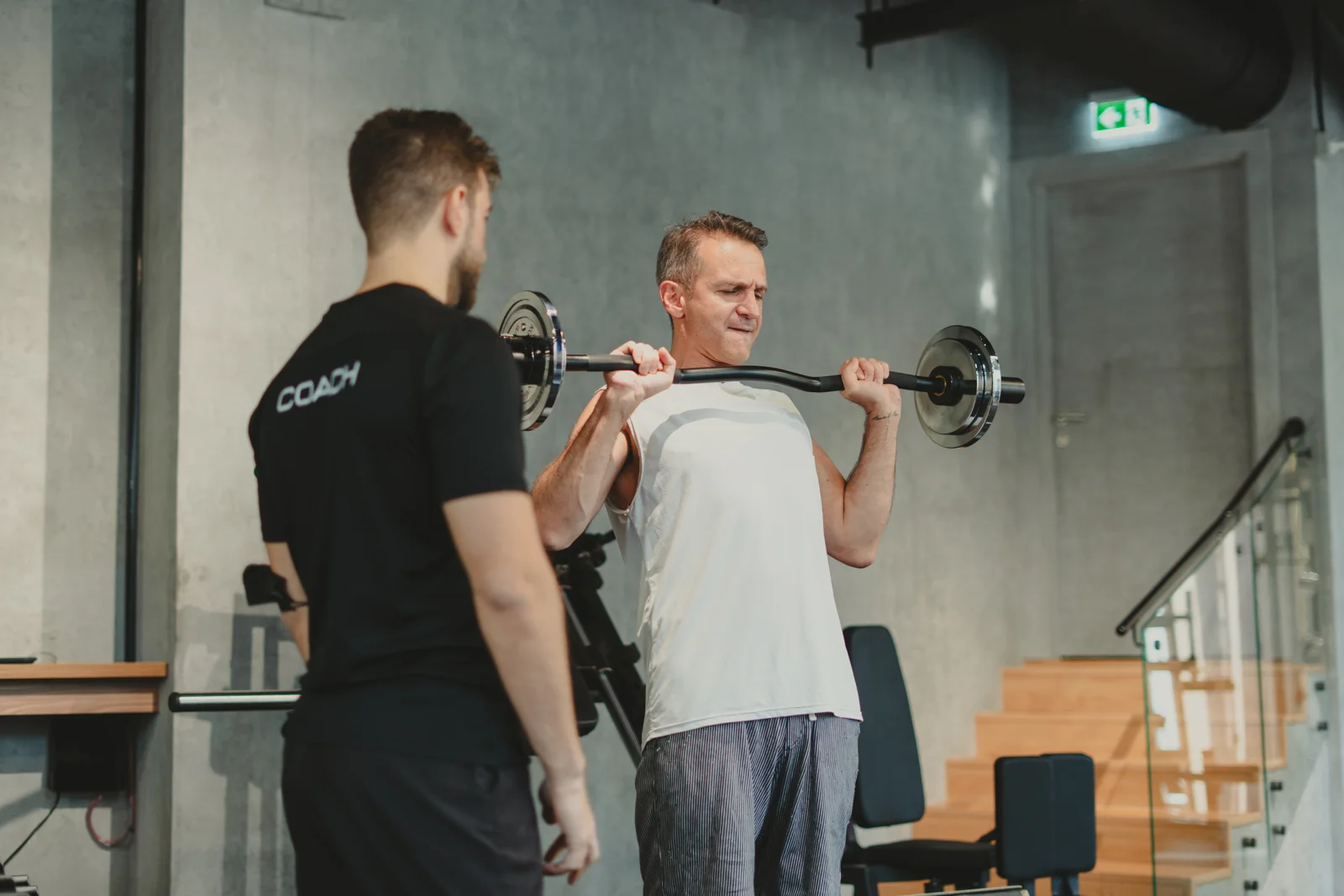
The value of a coach is highest during the hard sets. A small 12-week trial published in Medicine and Science in Sports and Exercise compared moderately trained men following an identical programme, with and without direct supervision. The supervised group increased their training loads faster and finished with greater squat and bench press strength (Mazzetti et al., 2000). It was a small study in young men, so treat it as a signal rather than a guarantee, but it matches what most coaches see: people tend to choose loads that are too light when no one is watching.
When you compare trainers, ask what a session looks like from start to finish. You want a short warm-up that prepares the main lifts, focused work on the exercises that matter for your goal, clear targets for each set, and notes that carry over to the next session. If the coach is on their phone or simply counting reps, you are paying for company.
Frequency matters too. The WHO physical activity guidelines recommend muscle-strengthening activity on two or more days a week alongside regular aerobic activity. Our article on how often to train with a personal trainer covers how to split that between coached and independent sessions.
Nutrition, recovery and the hours outside the studio
Training is one input. For body composition goals in particular, nutrition and sleep usually decide whether the work in the studio shows up on the scale and in the mirror. A complete programme should at least give you a practical nutrition structure that fits your work and social calendar, and a way to flag when sleep, stress or travel are pulling progress down.
Be cautious with two extremes: programmes that ignore nutrition entirely, and programmes that hand you a rigid meal plan nobody could follow through a normal Dubai week of client dinners and travel. The useful middle is a few clear targets you can hit most days, reviewed as your results come in.
Tracking and adjustments
Measurement is what separates a plan from a guess. A systematic review of behavioural weight-loss studies found a consistent link between self-monitoring of diet, exercise and weight and better outcomes, although the authors rated the overall evidence as weak because of study limitations (Burke et al., 2011). Tracking works best when someone reviews it with you and acts on it.
Ask any trainer three questions here: what will be measured, how often, and what happens when the numbers stall. A good answer names specific measures, a fixed review rhythm such as every two weeks, and a decision rule, for example adjusting volume, food targets or recovery before adding more sessions.
Questions to ask before you sign
What does the first assessment include, and will I get a written plan from it?
How is my plan progressed, and how often is it reviewed?
Who coaches my sessions, and will it be the same person each time?
What support do I get between sessions?
How is nutrition handled, and does it fit my real schedule?
What exactly is included in the total investment, and how long is the commitment?
If a trainer cannot answer these clearly, the price comparison does not matter yet.
How EVOLVE approaches this
Every EVOLVE programme follows the same five stages: Audit, Plan, Execution, Tracking and Adjustments. It starts with a consultation and an assessment, and every programme includes a blood panel covering 61 biomarkers so the plan is built on your own data. Anything that needs medical interpretation is referred to a qualified healthcare professional.
New-client sessions are 45 minutes, coached one to one in a private, appointment-only studio at Cayan Tower in Dubai Marina. Programmes run as 12-week or 12-month commitments, with scheduled checkpoints and accountability between sessions, because consistency over months is what moves results. You can read more about what accountability includes and what to expect from your first consultation.
FAQ
How much does a personal trainer cost in Dubai?
It varies widely with the format (gym floor, at home or private studio), the coach’s experience and what is included. Compare the total programme against its inclusions rather than the price per hour. At EVOLVE, your consultation confirms the exact setup, schedule and investment.
Is a package of sessions the same as a programme?
Not necessarily. A package is a number of hours. A programme adds an assessment, a written progression, measurement and scheduled reviews that decide what changes next.
How long should a first programme last?
Long enough to run at least two or three review cycles. Twelve weeks is a practical minimum to build habits, progress the main lifts and see a measurable trend.
Do I still need a coach if I already know how to train?
Experienced trainees often benefit most from objective programming, load targets and someone reviewing the data, especially when progress has stalled.
If you would like to see what a structured programme would look like for your goals and schedule, book your assessment.
Find your programme
Which programme fits you? Five questions.
Answer five questions and get a recommendation you can bring to your assessment. It takes about a minute.
Question 1 of 5
What do you want to change first?
Your next step
Book your assessment
A complimentary 1:1 consultation at the studio. We look at your goals, starting point and schedule, then recommend the right program.
Cayan Tower · Ground Floor, Shop 2Dubai Marina, Dubai, UAE
Get directions ↗
+971585987510
marketing@evolvedxb.ae